
Common Lawn and Garden Pests in Zone 6b: What to Watch For and What to Do
Every yard deals with insects. Most of the time they are harmless, and many are genuinely beneficial. But a handful of pests common to Zone 6b can cause real damage to lawns and ornamental plants if they go unnoticed long enough. Knowing what to look for, and what it actually means when you find it, makes the difference between catching something early and dealing with a much bigger problem later.
This guide covers the insects most likely to affect lawns and ornamental plants in this region, how to tell a harmful insect from a helpful one, and what to do if something looks off.
Start Here: What Does Your Damage Look Like?
Not sure where to begin? Use this table to match what you’re seeing to the most likely cause, then find that pest in the sections below.
|
|---|
Why Zone 6b Creates Ideal Conditions for Pests
Ohio’s climate in the USDA Hardiness Zone 6b range sustains a wide range of pest populations. Humid summers, clay-heavy soils that retain moisture, and a long growing season from roughly April through October mean that many insects can complete multiple life cycles in a single year. Warm springs accelerate egg hatch. Dry stretches in July and August stress turf and ornamental plants, making them more vulnerable to damage they might otherwise shrug off. The same conditions that make this region great for growing things also make it hospitable for the insects that feed on them.
That said, most pest problems are very manageable when caught at the right stage. The goal of this guide is to help you recognize what you’re looking at so you can respond appropriately, without overreacting to something harmless or missing something that genuinely needs attention.
The Insects Most Likely to Affect Your Lawn
White Grubs
White grubs are the larvae of several beetle species, most commonly masked chafers and Japanese beetles, though June beetles also contribute. They are white, C-shaped, and live just below the soil surface feeding on grass roots.
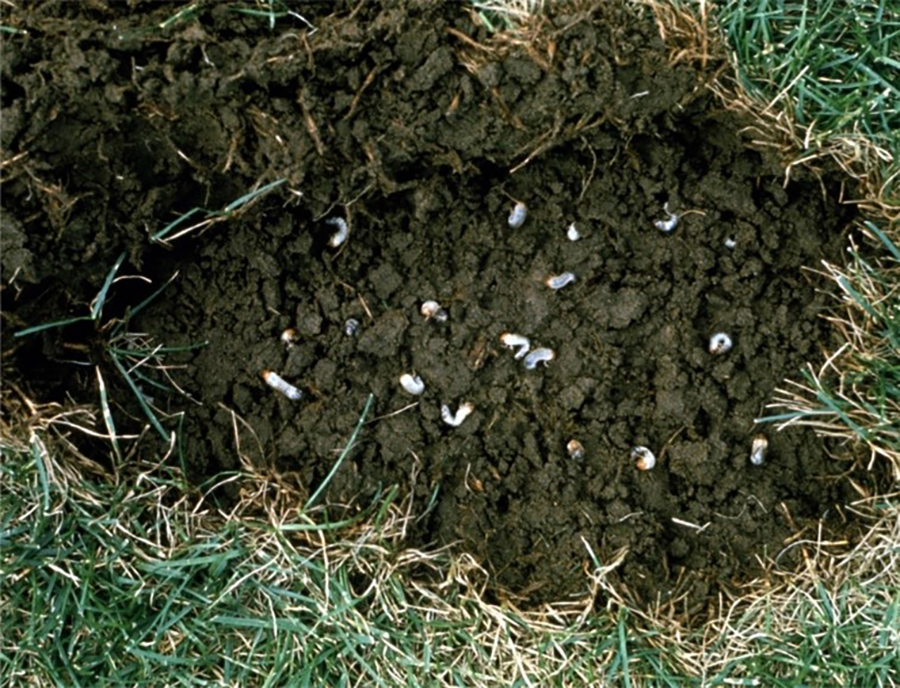
Image 1
A healthy lawn can tolerate a few grubs without showing any damage at all; it’s when populations build up that problems appear.
- What to look for: Irregular brown patches that don’t green up after rain, even when surrounding grass recovers normally. The clearest sign is turf that lifts away from the soil in a mat with little resistance, because the roots holding it in place have been severed.
- When it happens: Grubs hatch in late summer and are most active, and most damaging, from August through September when they are feeding near the soil surface.

Image 2
- How to check: Pull up a section of turf at the edge of a damaged area. Count the white, C-shaped larvae in the soil beneath. Ten or more per square foot in a sample area is generally the threshold where treatment makes sense.
- Don’t confuse with: Drought stress, which looks nearly identical from a distance. The tug test is the difference: drought-stressed turf resists pulling, while grub-damaged turf lifts away cleanly.
Timing matters a great deal with grubs. The window for effective treatment is late summer, when grubs are young and near the surface. Grubs that have matured and moved deeper into the soil for winter are much harder to reach. One detail worth knowing for this part of Ohio: masked chafers have largely replaced Japanese beetles as the dominant white grub species in recent years, according to OSU Extension. Grub treatments work regardless of species, so this does not change the approach, but it is useful context.
Japanese Beetles
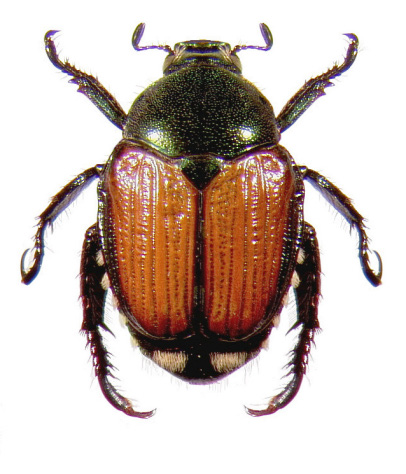
Image 3
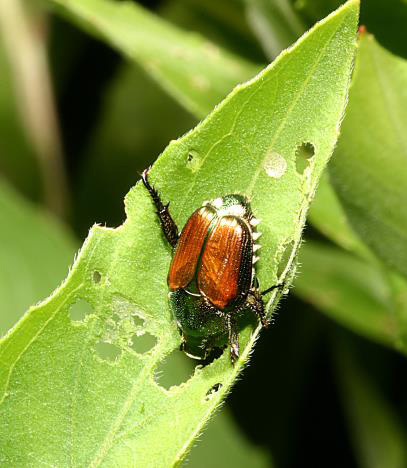
IMAGE 4
Japanese beetles cause damage in two distinct ways. The adults feed on ornamental plants above ground, and their larvae, which are white grubs, feed on grass roots below. Managing the two stages involves different timing and different approaches.
- What to look for above ground: Lacy, skeletonized leaves on susceptible plants. The beetles eat the tissue between the leaf veins and leave the veins intact, which gives damaged leaves a distinctive see-through appearance. Roses, lindens, crabapples, Japanese maples, and birch are among their preferred targets.
- When adults are active: Late June through July into early August. They emerge, feed, and are largely gone within a few weeks.
- What to do about adults: For small infestations, knocking beetles into a bucket of soapy water in the early morning, when they are sluggish, is effective. For heavier pressure on a specific plant, targeted contact insecticides applied directly to the plant are more reliable. Pheromone-based beetle traps are widely sold but not recommended; research consistently shows they attract more beetles than they catch.
- What to do about larvae: Grub-targeted soil treatments applied in late summer address the root damage caused by Japanese beetle larvae. See the White Grubs section above for timing and threshold guidance.
Chinch Bugs
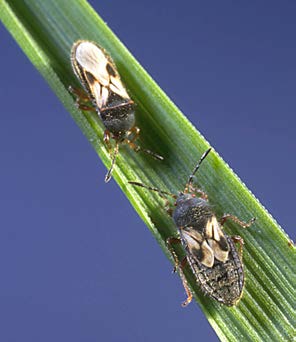
Image 5
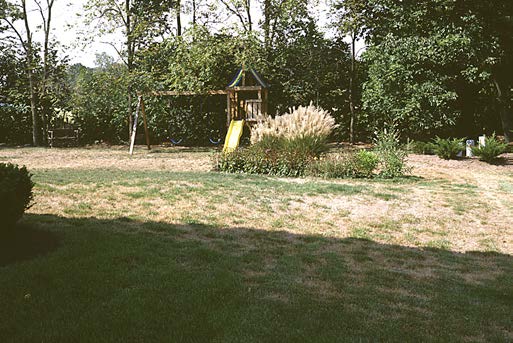
Image 6
Chinch bugs are small insects that feed by piercing grass blades and sucking out the sap. They are most active during hot, dry weather and tend to show up first in the most stressed parts of a lawn.
- What to look for: Irregular yellow patches that turn straw-colored and keep expanding despite watering. Damage typically appears near driveways, sidewalks, south-facing slopes, or anywhere the lawn dries out quickly.
- When it happens: Late June through August, with the worst damage during dry heat waves.
- How to check: Part the grass at the edge of a damaged area and look into the thatch layer. Adult chinch bugs are small, less than a quarter inch, with white wings marked by a black triangular spot. Nymphs are smaller and may appear reddish or orange.
- Don’t confuse with: Grub damage. Chinch bug damage holds together when you pull the turf. Grub-damaged turf lifts away in a mat.
A healthy, well-watered lawn resists chinch bug damage better than a stressed one. Perennial ryegrass, tall fescue, and fine fescue are also less preferred by chinch bugs than Kentucky bluegrass, so grass species plays a role in long-term susceptibility.
The Insects Most Likely to Affect Your Ornamental Plants and Shrubs
Aphids
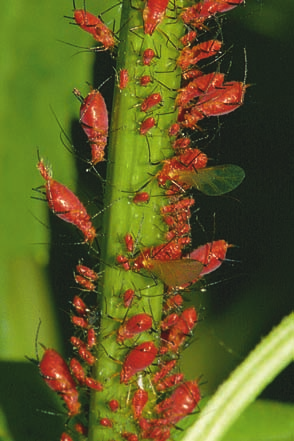
Image 7
Aphids are one of the most common insects in any landscape, and for most of the season on most plants, they are not a serious problem. Natural predators, particularly lady beetles and lacewings, keep populations in check under normal conditions. When they do build up, they are usually straightforward to address.
- What to look for: Curled, puckered, or yellowed leaves, particularly on new growth. Sticky residue on leaf surfaces, or a black sooty mold growing on that residue. Small, soft-bodied insects clustered on stem tips and the undersides of leaves in a range of colors including green, yellow, black, and woolly white.
- When it happens: Spring through fall, with populations capable of building quickly during warm stretches.
- First step: Wait a few days after spotting a small colony. Lady beetles and lacewings often arrive on their own and handle the problem without any intervention.
- When to treat: If the population is large or predators have not arrived, a strong spray of water to dislodge them or an application of insecticidal soap directly to the colonies is usually sufficient. Reserve systemic insecticides for severe or persistent infestations, and avoid applying them to blooming plants where pollinators are active.
Spider Mites
Spider mites are not insects. They are arachnids, more closely related to spiders than to beetles or moths, and they are one of the more common causes of ornamental plant damage during hot, dry stretches of summer.
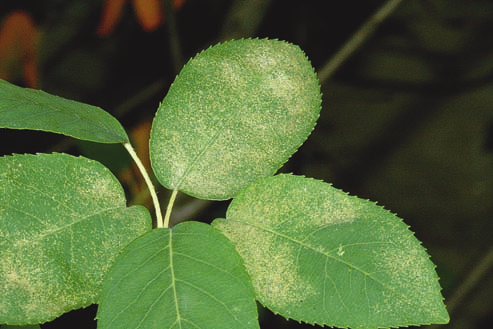
Image 8
- What to look for: Fine stippling or speckling on leaves, as if the surface has been lightly sandblasted. Thin webbing on the undersides of foliage or between leaves and stems. Plants with heavy infestations develop a bronzed, dull appearance and may drop leaves.
- When it happens: Mid to late summer, particularly during periods of heat and low humidity.
- How to confirm: Hold a piece of white paper under a branch and tap it firmly. If tiny moving specks appear on the paper, mites are present.
- How to treat: Horticultural oil or insecticidal soap applied to both leaf surfaces can be effective. Adequate irrigation during dry stretches is one of the better preventive measures, since plants under water stress are significantly more vulnerable. Avoid broad-spectrum insecticides for mite problems; they often kill the natural predators that keep mite populations in check and can make the situation worse.
Bagworms
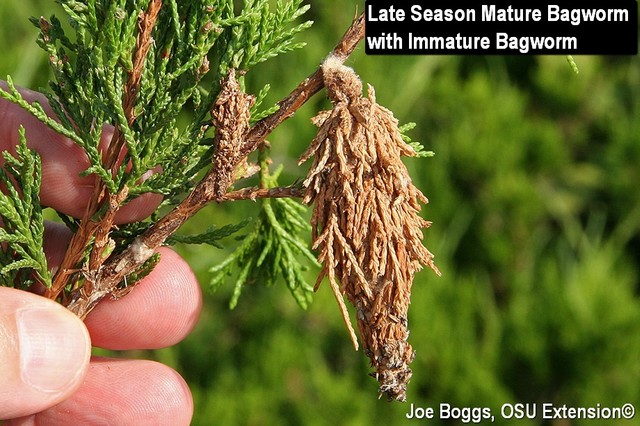
Image 9
Bagworms are a genuine concern for arborvitae, juniper, and other evergreens, but they are also very manageable when caught at the right time. The caterpillars build distinctive cone-shaped bags from silk and plant material and hang them from branches while feeding inside.
- What to look for: Cone-shaped bags, one to two inches long, made of silk and bits of foliage, hanging from branch tips. Browning or thinning in arborvitae, juniper, or pine, particularly when it starts in one area and spreads.
- When it happens: Eggs hatch in late May through June. Feeding accelerates through July and August as the larvae grow.
- The timing that matters most: Young larvae in late May and early June are far more susceptible to treatment than mature larvae in July and August, which are well-protected inside thicker bags. Catching bagworms early in the season makes treatment significantly more effective.
- A simple off-season step: If you find bags in fall or winter, remove and destroy them by hand. Each bag can contain hundreds of eggs, and removing them reduces the pressure for the following season considerably.
- Don’t confuse with: General browning from winter burn or drought. The bags themselves are the giveaway. Even early-season bags have a distinct teardrop shape.
Scale Insects
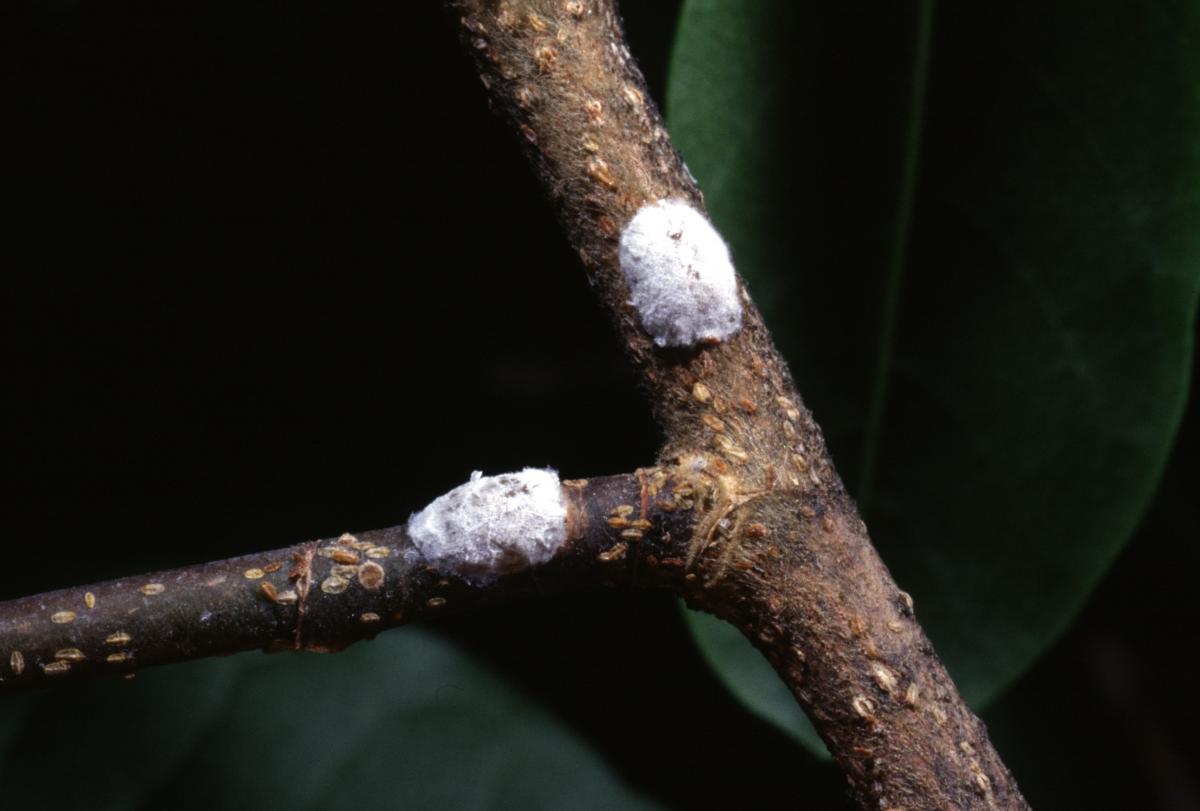
Image 10
Scale insects are easy to overlook because they do not move and do not look like insects at all. There are many different kinds, and they attach to stems and leaf undersides and feed slowly, which means infestations often go unnoticed until damage is already significant.
- What to look for: Small, waxy or shell-like bumps on stems and the undersides of leaves, white, tan, or brown depending on species. Yellowing foliage, twig dieback, sticky residue, or black sooty mold are common accompanying signs.
- When to treat: The most effective window is late winter to early spring, before new growth emerges. Horticultural oil applied at this stage smothers overwintering scale and eggs effectively. Summer applications are also used but require care to avoid plant burn in high heat.
- Plants to watch: Euonymus is particularly susceptible. Broadleaf evergreens and fruit trees are also commonly affected.
Boxwoods: What’s Actually Going On
Boxwoods are one of the most widely planted landscape shrubs in this region, and right now they are also one of the most talked-about. Between box tree moth, boxwood blight, winter burn, and normal stress from poor siting, a lot of homeowners are looking at their boxwoods and wondering what went wrong. The good news is that most boxwood problems are diagnosable and treatable, and many of them are not as serious as they look.
Here is a brief rundown of the most common causes of boxwood decline and how to tell them apart.
Box Tree Moth
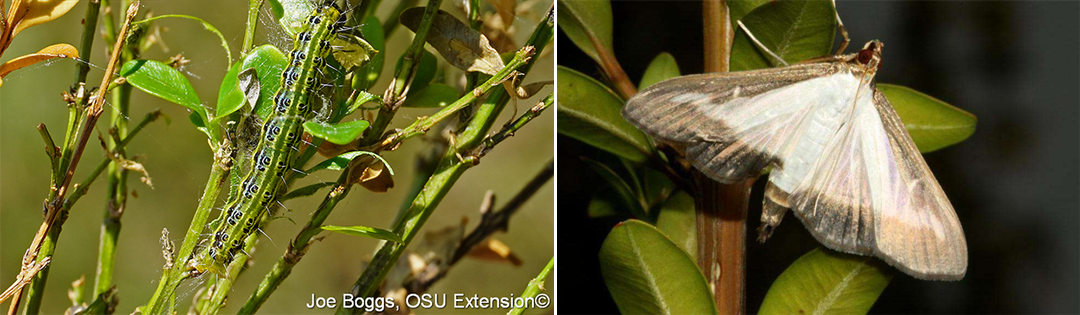
Image 11
Box tree moth is an invasive pest confirmed in Ohio and still spreading. The quarantine zone as of early 2026 includes Montgomery, Greene, Warren, Butler, Miami, Clermont, Hamilton, Preble, and Clark counties. If you are in or near those areas and have boxwoods, it is worth knowing what to look for.
- What to look for: Green and yellow striped caterpillars with black markings, found inside the plant when you part the branches. Small silk webbing between interior stems. Browning that starts from the inside of the plant and works outward.
- The distinction: Box tree moth caterpillars are only found on boxwoods. If you see the striped larvae inside your plant, that is a strong identification. If your boxwood is browning but you find no caterpillars, the cause is likely something else.
- What to do: If you find caterpillars, report the sighting to the Ohio Department of Agriculture through their online reporting tool, and contact a landscape professional for treatment guidance. OSU Extension recommends against preventive insecticide applications unless an active infestation is confirmed, since unnecessary treatments can harm beneficial insects.
The honest message here is that box tree moth is manageable. It is not an automatic death sentence for your boxwoods. Caught early and addressed appropriately, most plants can be treated effectively.
Boxwood Blight
Boxwood blight is a fungal disease that causes leaf spots, rapid defoliation, and dark streaking on stems. It tends to spread quickly in warm, wet conditions and can move between plants through shared tools or physical contact. Unlike box tree moth, which starts from the inside out, boxwood blight typically affects the outer foliage first with visible lesions.
Winter Burn
Winter burn is extremely common and often alarming to homeowners who have not seen it before. It happens when boxwood foliage loses moisture through the leaves during cold, windy weather faster than the roots can replace it, particularly when the ground is frozen. The result is browning that looks severe but is often not. Affected plants frequently push new growth in spring and recover well. Anti-desiccant sprays applied in late fall can reduce the risk.
If your boxwoods are showing decline and you are not sure why, having a knowledgeable set of eyes on the plants is the most straightforward path to an accurate answer. Grunder Landscaping’s LandKeeping crews inspect ornamental plants every two weeks from April through November specifically to catch these kinds of issues early, before they become harder to address. Our plant health care services also include targeted treatments for pests and disease when they are warranted.
Invasive Pests to Know About
Spotted Lanternfly
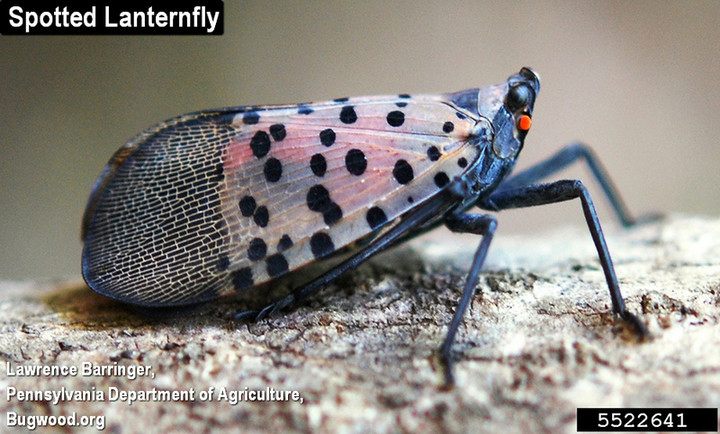
Image 12
The spotted lanternfly is now established across Ohio. The Ohio Department of Agriculture issued a statewide quarantine in February 2026. It is worth knowing what it looks like and what practical steps to take, though it is not a reason to panic about your landscape.
- What to look for: Gray wings with black spots and bright red hindwings visible in flight. Nymphs are black with white spots in early instars and develop red coloring later in summer. Large congregations often appear on tree of heaven, grapevines, and maples in late summer.
- When it happens: Nymphs emerge in spring. Adults are most visible July through October.
- What to do: Squish adults and nymphs when you see them. Check outdoor furniture, vehicles, and equipment for gray, putty-like egg masses before moving them to a new location. If you have tree of heaven on your property, removing it reduces a primary attractant.
Spotted lanternfly feeds on a wide range of plants but is most damaging to grapevines and certain fruit trees. For most residential ornamental landscapes, the impact is manageable.
The Insects You Want in Your Yard
Before treating anything, it is worth knowing what you are actually looking at. Most insects in a healthy landscape are either neutral or actively beneficial, and a reflex to spray does more harm than good more often than people realize.
Lady Beetles
Lady beetles, commonly called ladybugs, are Ohio’s official state insect and one of the most effective aphid predators around. Both adults and larvae feed on aphids, spider mites, scale, and mealybugs. The adult form is familiar: dome-shaped, typically orange or red with black spots. The larvae look quite different and are often mistaken for pests. They are elongated, dark-colored, and spotted with orange or yellow, and they move quickly along stems and leaves. If you see them, leave them alone.
Green Lacewings
Green lacewings are delicate, pale green insects with large, veined wings. The adults feed on nectar and pollen and are harmless to plants. The larvae, sometimes called aphid lions, are a different story entirely. They are voracious predators of aphids, mites, thrips, whiteflies, and small caterpillars, and they are effective enough that lacewing eggs and larvae are sold commercially as a biological control. If you see them near an aphid colony, they are doing exactly the job you would want.
Ground Beetles
Ground beetles are nocturnal predators that hide in mulch, leaf litter, and soil during the day and emerge at night to hunt cutworms, grubs, slugs, and other soil-dwelling pests. They are dark, often iridescent, and fast-moving when disturbed. Because they live in the same habitat as many pest larvae, they provide ongoing pest control that is easy to undermine with broad-spectrum soil insecticide applications.
The practical point with all of these beneficial insects is the same: when you see insect activity on a plant, take a moment to identify what you are looking at before reaching for a treatment. Spraying a broad-spectrum insecticide at an aphid colony that already has lady beetles working through it often sets things back rather than moving them forward.
Pests That Keep YOU out of YOUR yard
Not every pest problem shows up in your plants or your lawn. Some of the most frustrating ones are the insects that keep you from enjoying your outdoor space altogether. If you find yourself avoiding your patio in the evening or worrying about your kids and pets in the yard, targeted treatments can make a real difference. Common culprits include:
- Mosquitoes
- Ticks
- Fleas
- Ants, stink bugs, and other perimeter pests
A professional can assess your property, identify where these pests are harboring, and recommend a treatment plan that addresses the problem without disrupting the rest of your landscape.
How to Diagnose What You’re Dealing With
A few simple steps can help you figure out what is going on before deciding how to respond.
Look at the pattern of damage.
Irregular brown patches in turf that lift away from the soil point to grubs. Patches that hold together but don’t recover with watering may be chinch bugs or sod webworms. Streaks of yellowing near pavement often indicate chinch bug activity. Uniform brown patches that follow drainage patterns are more likely a disease than an insect.
Check the timing.
Grub damage becomes visible in late August and September. Chinch bug damage peaks in hot, dry stretches of July and August. Bagworm feeding accelerates through June and July. Japanese beetle adult feeding is concentrated in July. The season alone can significantly narrow down what you’re dealing with.
Get close and look carefully.
Aphids congregate on the undersides of leaves and on new growth. Spider mites produce fine webbing that is easier to see in morning light. Bagworm bags hang from branch tips and are often initially small enough to overlook. Scale looks like part of the bark or stem until you examine it closely. A few minutes of hands-on inspection resolves a lot of uncertainty.
Photograph what you find.
A clear photo of the insect, the damage pattern, and the affected plant gives a landscape professional everything needed to make a confident identification.
Keeping Pests in Check:
Healthy plants and healthy turf are naturally more resilient to pest pressure. Most pest management comes down to maintaining good conditions, catching problems early, and treating only when and where treatment is actually warranted.
Maintain appropriate mowing height.
Cutting turf shorter than recommended for the grass species stresses the root system and reduces the lawn’s ability to recover from insect feeding. Tall fescue, Kentucky bluegrass, and perennial ryegrass each have an optimal mowing range for Zone 6b, and staying within it matters, especially during the heat of summer.
Water deeply and infrequently.
Frequent shallow watering encourages shallow root systems that are more vulnerable to grub damage and heat stress. Watering deeply and less often, enough to soak several inches into the soil, builds deeper root systems that are more resilient. For some pest problems, like chinch bugs, avoiding excessive irrigation during spring can also reduce the lawn’s attractiveness to egg-laying adults.
Let the Experts Help
The most reliable thing you can do to stay ahead of pest problems is have someone knowledgeable looking at your plants on a regular basis. Most infestations that become expensive or difficult to treat got that way because they went unnoticed through the early stages, when they are easiest to address. A dedicated landscape maintenance program puts trained eyes on your property every two weeks from April through November, catching issues before they escalate and treating with targeted products timed to the pest’s life cycle rather than broad-spectrum applications that can eliminate the beneficial insects already working in your favor.
When to Call a Professional

Most pest problems are manageable when caught early. A few situations are worth getting professional eyes on rather than handling alone.
A grub count consistently above ten per square foot across multiple areas of the lawn warrants professional-grade treatment timed correctly to the pest’s life cycle. Bagworm infestations that have spread across multiple plants or where bags are large and numerous are difficult to address effectively without professional-grade products applied at the right time. Box tree moth questions are best answered by someone who can inspect the plant in person and make an accurate identification before any treatment decisions are made. And when damage is recurring year after year or has causes that are not clear from visual inspection, a professional assessment saves time and money compared to guessing.
Grunder Landscaping offers plant health care services that include dormant oil applications, targeted insecticide treatments, and ongoing monitoring for insect and disease pressure on ornamental plants. Perimeter pest control, mosquito control, and flea and tick treatments are also available for lawn and landscape areas and can be structured to cover your property through the full pest season.
About Grunder Landscaping Co.
Grunder Landscaping Co. has been designing, installing, and maintaining landscapes in the Dayton area since 1984 and has served the Cincinnati market for more than a decade. We know this climate well, the pest pressures that come with it, and the approaches that consistently work. If something in your yard has you stumped and you want a maintenance program that keeps your lawn and plants healthy before problems have a chance to start, our team is here to help. Visit grunderlandscaping.com to get started.
Image sources:
Image 1: https://ohioline.osu.edu/factsheet/ent-0107
Image 2, 3, 4: https://ohioline.osu.edu/factsheet/ENT-46
Image 5, 6: https://ohioline.osu.edu/factsheet/HYG-2503-11
Image 7: https://ohioline.osu.edu/factsheet/HYG-2031-10
Image 8: https://ohioline.osu.edu/factsheet/HYG-2012-11
Image 10: https://ohioline.osu.edu/factsheet/ENT-61
Image 11: https://agri.ohio.gov/divisions/plant-health/invasive-pests/invasive-insects/btm
get started